
Not Everything That Sounds Smart Is True
How to Spot Wellness Misinformation—and Start Trusting Yourself Instead
Hey friend,
Every week, I watch smart, thoughtful humans get pulled in by wellness content that sounds authoritative but isn't. Posts with just enough science-adjacent language to feel credible. Influencers who speak with absolute certainty about things real scientists would never state so definitively.
And here's what bothers me most about it: this kind of content doesn't just misinform you. It trains you to look outside yourself for answers that, in many cases, your own body is already trying to give you.
When you're navigating something as personal as your health—especially on a GLP-1 medication or going through a body transition—the desire for clear, definitive answers is completely human. Uncertainty is uncomfortable. We want someone to just tell us what to do. But that desire is exactly what makes us vulnerable to people who are more interested in your attention (or your wallet) than your well-being.
Today I want to give you two things: the tools to spot the noise, and the permission to start building something far more powerful—your own informed intuition about what your body needs.
Why We're Wired to Believe It

It's not because we're gullible—it's because we're human. A landmark 2018 study in Science analyzed over 126,000 stories on social media and found that false information spread significantly faster and farther than truth. Why? It triggers stronger emotional reactions—surprise, fear, disgust—making it more shareable. And humans, not bots, were primarily responsible [1].
Add to that our natural "truth bias"—our tendency to believe what we're presented with unless given strong reason not to—and algorithms that reward emotionally provocative content with greater reach, and you have a perfect storm for wellness misinformation [2].
But there's something else happening too. Every time you outsource your health decisions to a stranger on the internet—every time you override what your body is telling you because an influencer told you something different—you're eroding your own ability to listen to yourself. That matters. Because no one lives in your body but you.
Seven Red Flags—With Real-World Examples

1. Absolute language. "Always," "never," "cures," "guaranteed." Real science uses language like "the evidence suggests" or "in this population, we observed." Anyone flattening human complexity into universal promises is either uninformed or selling something.
The example: "Seed oils are TOXIC and are poisoning you." This claim has gone massively viral across TikTok, podcasts, and Instagram. The reality? Johns Hopkins, Harvard, Stanford, and the American Heart Association all confirm that seed oils are not toxic. A nutrition scientist at Johns Hopkins put it plainly: "There is abundant evidence suggesting that seed oils are not bad for you. If anything, they are good for you." Research shows the fatty acids in seed oils are associated with lower risk of cardiovascular disease, stroke, and type 2 diabetes. The "toxic" framing is a textbook example of absolute language designed to provoke fear, not inform [3] [4] [5].
2. Cherry-picked studies. One study is a conversation starter, not a conclusion. Trustworthy sources discuss the body of evidence and acknowledge limitations.
The example: Wellness influencers routinely cite single case reports—the lowest form of evidence—as definitive proof. The American Council on Science and Health documented how one prominent influencer cited a case series of just four people to claim manufactured citric acid causes allergies, asthma, and chronic inflammation—then built an entire product recommendation around it [6].
3. Misleading credentials. A registered dietitian and a weekend-certified "nutrition specialist" are not the same thing. A naturopath, a chiropractor, and a board-certified endocrinologist all might use the title "doctor." Look at what the credential is, not just that one exists.
The example: "Adrenal fatigue" was coined in 1998 by a naturopath and chiropractor and has since been popularized by practitioners selling supplements to treat it. A systematic review in BMC Endocrine Disorders concluded definitively: "There is no substantiation that 'adrenal fatigue' is an actual medical condition. Therefore, adrenal fatigue is still a myth." The Endocrine Society, Harvard, and Cedars-Sinai all agree—and warn that the supplements sold to "treat" it can actually shut down your adrenal glands [7] [8] [9].
4. Demonizing or glorifying a single thing. Health is a system, not a toggle switch. Context, dose, and individual variation always matter.
The example: "You need to do a juice cleanse to detox your body." This claim has been thoroughly debunked. The National Center for Complementary and Integrative Health (part of NIH) states there is no compelling research to support detox diets for eliminating toxins—your liver and kidneys already do this 24/7. Johns Hopkins hepatologists do not recommend liver cleanses, and the FDA has taken action against companies making false detox claims. Some cleanse products have actually been found to cause liver injury [10] [11].
5. Emotional manipulation disguised as empowerment. "Your doctor doesn't want you to know this" positions the creator as a truth-teller while isolating you from qualified professionals. Research confirms wellness influencers consistently undermine trust in public health authorities [2]. This is especially harmful if you're on a GLP-1 and already navigating stigma.
The example: "Leaky gut syndrome" is frequently diagnosed by alternative practitioners—often via unvalidated blood or stool tests—and then "treated" with expensive supplement protocols. A 2024 review published in Gastroenterology & Hepatology by Mayo Clinic researchers stated clearly: leaky gut syndrome "is not currently accepted as a formal medical diagnosis," no validated test exists, and the treatments being sold are "unproven, sometimes dangerous." Intestinal permeability is a real phenomenon in certain diseases, but the leap to a catch-all diagnosis with a supplement cure is not supported by science [12] [13].
6. Fear-mongering as a business model. Creating pseudo-diagnoses, listing vague universal symptoms, then offering a product as the solution—that's a sales funnel, not healthcare. A meta-analysis in Psychological Bulletin found that chronic exposure to fear-driven content leads to defensive avoidance—people stop engaging with all health information to protect their mental well-being [14].
7. Before-and-after photos without context. Lighting, posture, clothing, hydration, and facial expression can dramatically change how a body looks. A photo tells you nothing about sustainability, mental health, or what was sacrificed to get there.
The AI Wild Card
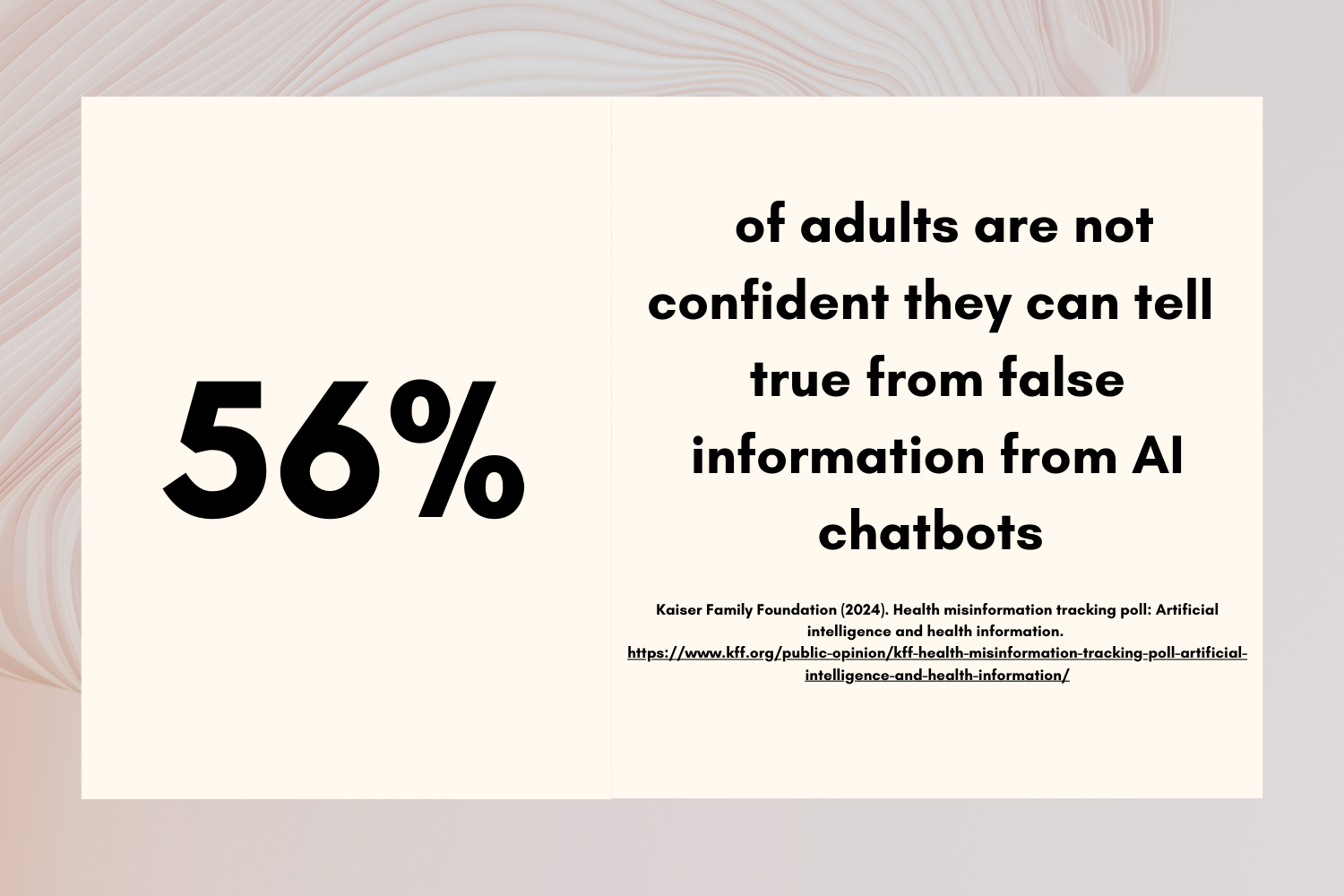
AI-generated wellness content is flooding social media. A 2026 study from Mount Sinai, published in The Lancet Digital Health, tested nine AI models with over a million prompts and found they readily repeated false medical claims when wrapped in clinical-sounding language [15]. Meanwhile, a KFF poll found most adults can't distinguish true from false AI-generated health content [16].
Signs of AI-generated content: perfectly polished but oddly generic, heavy on filler phrases, and lacking any personal experience or original perspective. It's correct-sounding but shallow. But whether content is AI-generated or human-written, the evaluation criteria should be the same.
What Trust Actually Looks Like
✓ Cites specific, findable research
✓ Transparent about credentials and limitations
✓ Acknowledges individual variation; encourages working with your healthcare team
✓ Informative tone, not urgent or fear-driven
✓ Discloses financial relationships
Now, the Part No One Talks About: Learning to Trust Yourself

Here's what I think gets lost in the conversation about misinformation. We spend a lot of time talking about what not to believe—and that's important. But we rarely talk about what to put in its place.
And what I want you to put in its place is you.
Not blind confidence. Not ignoring expert guidance. I mean developing a genuine, grounded relationship with your own body so that when someone online tells you seed oils are destroying your health or you need a three-day juice cleanse or your adrenals are failing—you have an internal compass that says, let me check that before I take it on.
That compass doesn't come from consuming more content. It comes from paying attention. From noticing how foods actually make you feel, not how an influencer says they should make you feel. From tracking your energy, your sleep, your mood, your digestion—not against someone else's benchmarks, but against your own patterns. From learning to distinguish between a genuine signal from your body and an anxiety response triggered by something you just read online.
This is body awareness, and it is a skill. Like any skill, it gets stronger with practice. And it is, in my professional opinion, the single most underrated tool in the wellness space.
Because when you develop real insight into what your body needs—when you combine that self-knowledge with guidance from qualified professionals who know your history—you become very, very hard to manipulate. You stop being a passive consumer of wellness content and start being an active, informed participant in your own health.
That's not something anyone can sell you in a supplement. It's something you build.
Your Homework
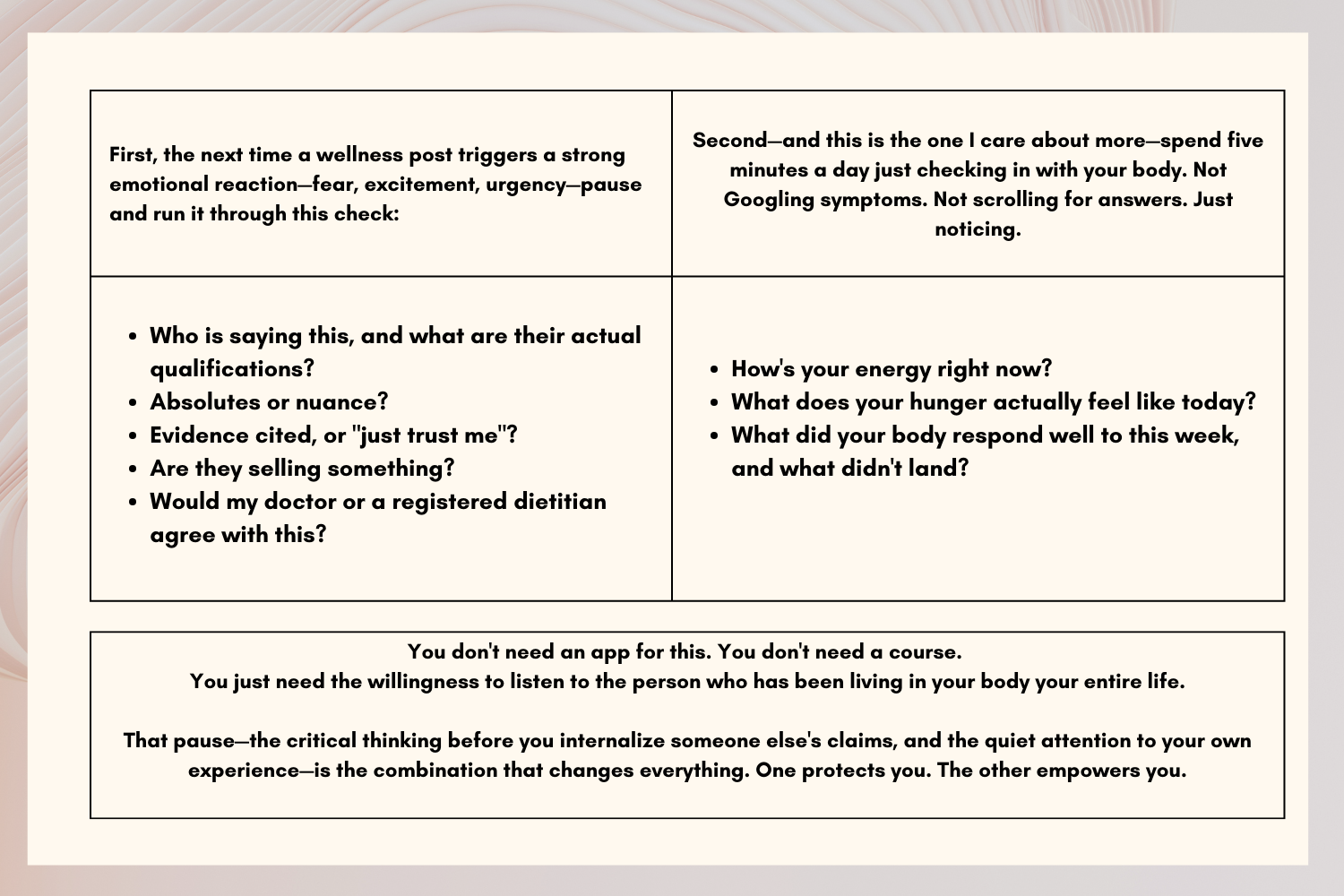
Screengrab this image for future reference
Two things this week:
First, the next time a wellness post triggers a strong emotional reaction—fear, excitement, urgency—pause and run it through this check:
Who is saying this, and what are their actual qualifications?
Absolutes or nuance?
Evidence cited, or "just trust me"?
Are they selling something?
Would my doctor or a registered dietitian agree with this?
Second—and this is the one I care about more—spend five minutes a day just checking in with your body. Not Googling symptoms. Not scrolling for answers. Just noticing.
How's your energy right now?
What does your hunger actually feel like today?
What did your body respond well to this week, and what didn't land?
You don't need an app for this. You don't need a course. You just need the willingness to listen to the person who has been living in your body your entire life.
That pause—the critical thinking before you internalize someone else's claims, and the quiet attention to your own experience—is the combination that changes everything. One protects you. The other empowers you.
To your clarity and your confidence,
Sally
Board-Certified Health & Wellness Coach (NBC-HWC), MSc Psych.
References
[1] Vosoughi, S., Roy, D., & Aral, S. (2018). The spread of true and false news online. Science, 359(6380), 1146–1151. https://www.science.org/doi/10.1126/science.aap9559
[2] Denniss, E. et al. (2025). Social media and the spread of misinformation: Infectious and a threat to public health. Health Promotion International, 40(2). https://pmc.ncbi.nlm.nih.gov/articles/PMC11955583/
[3] Marklund, M. et al. (2025). The evidence behind seed oils' health effects. Johns Hopkins Bloomberg School of Public Health. https://publichealth.jhu.edu/2025/the-evidence-behind-seed-oils-health-effects
[4] American Heart Association (2024). There's no reason to avoid seed oils and plenty of reasons to eat them. https://www.heart.org/en/news/2024/08/20/theres-no-reason-to-avoid-seed-oils-and-plenty-of-reasons-to-eat-them
[5] Harvard T.H. Chan School of Public Health (2022). Scientists debunk claims of seed oil health risks. https://hsph.harvard.edu/news/scientists-debunk-seed-oil-health-risks/
[6] Suleta, K. (2024). Weaponizing fear: The wellness industry cashes in. American Council on Science and Health. https://www.acsh.org/news/2024/11/26/weaponizing-fear-wellness-industry-cashes-49131
[7] Cadegiani, F. A. & Kater, C. E. (2016). Adrenal fatigue does not exist: A systematic review. BMC Endocrine Disorders, 16(48). https://pubmed.ncbi.nlm.nih.gov/27557747/
[8] Endocrine Society (2022). Adrenal fatigue. https://www.endocrine.org/patient-engagement/endocrine-library/adrenal-fatigue
[9] Harvard Health Publishing (2020). Is adrenal fatigue "real"? https://www.health.harvard.edu/blog/is-adrenal-fatigue-real-2018022813344
[10] National Center for Complementary and Integrative Health (NIH). "Detoxes" and "cleanses": What you need to know. https://www.nccih.nih.gov/health/detoxes-and-cleanses-what-you-need-to-know
[11] Johns Hopkins Medicine. Detoxing your liver: Fact versus fiction. https://www.hopkinsmedicine.org/health/wellness-and-prevention/detoxing-your-liver-fact-versus-fiction
[12] Lacy, B. E. et al. (2024). Leaky gut syndrome: Myths and management. Gastroenterology & Hepatology. https://pubmed.ncbi.nlm.nih.gov/39193076/
[13] Cleveland Clinic (2025). Leaky gut syndrome. https://my.clevelandclinic.org/health/diseases/22724-leaky-gut-syndrome
[14] Tannenbaum, M. B. et al. (2015). Appealing to fear: A meta-analysis of fear appeal effectiveness and theories. Psychological Bulletin, 141(6), 1178–1204. https://pmc.ncbi.nlm.nih.gov/articles/PMC5789790/
[15] Icahn School of Medicine at Mount Sinai (2026). Can medical AI lie? Large study maps how LLMs handle health misinformation. The Lancet Digital Health. https://www.mountsinai.org/about/newsroom/2026/can-medical-ai-lie-large-study-maps-how-llms-handle-health-misinformation
[16] Kaiser Family Foundation (2024). Health misinformation tracking poll: Artificial intelligence and health information. https://www.kff.org/public-opinion/kff-health-misinformation-tracking-poll-artificial-intelligence-and-health-information/