
A is for Apple Cider Vinegar: Sour Wine, Snake Oil, and a Little Bit of Science

ACV — apple cider vinegar benefits and science explained
A note from your Coaching Friend before we dive in:
I'm a Board-Certified Health & Wellness Coach (NBC-HWC) with a Master's in Psychology. My expertise is in behavioral change — helping you think differently about health, build habits that actually stick, and navigate the wonderfully messy human side of it all. This series is purely informational. It is not medical advice, a prescription, or a treatment plan. My goal is to hand you the science, call out the hype, and trust you to make empowered, informed decisions for your own body. Always loop in your doctor or a registered dietitian before adding new supplements — especially if you're managing a health condition or taking medication. We good? Great. Let's dig in.
Welcome to the A–Z Wellness Series
Every week, we're going alphabetically through the wellness world — cutting through the noise, looking at the actual science, and figuring out what's worth your time, your money, and your morning routine. No miracle cures. No fear-mongering. Just facts, a healthy dose of scepticism, and the occasional joke at the wellness industry's expense.
Third up (see previous blogs about Creatine and Collagen): the sour little overachiever that has somehow convinced millions of people to drink vinegar before breakfast. Apple. Cider. Vinegar.
A Brief History of Drinking Something Awful and Calling It Medicine
Let's start at the beginning, because the origin story of ACV is genuinely one of my favorites.
Vinegar was almost certainly discovered by accident — when someone left their wine or cider uncovered too long and it turned sour. And here's the important bit: rather than tip it down the drain like a sensible person, someone drank it anyway and decided it was medicinal. That was approximately 7,000 years ago, and we have not stopped since.
In fact, the word vinegar comes from the Latin vinum acre — meaning "sour wine." Not "ancient elixir." Not "metabolic miracle." Sour wine that went wrong. That's the full origin story of your wellness cabinet staple.
The Babylonians were using it as a food preservative around 5,000 BC. Ancient Egyptian urns containing vinegar residue have been dated to 3,000 BC. During biblical times it was used as medicine and — somewhat relatedly — as an energising drink for labourers. Roman soldiers drank it. Samurai warriors drank it for power and strength. ACV didn't spread around the world because of health breakthroughs; it spread, rather brilliantly, as an affordable substitute for booze. You're essentially drinking the peasant ration of the ancient world before your morning emails.
In 400 BC, Hippocrates — the father of modern medicine, and a man who also enthusiastically prescribed leeches — recommended apple cider vinegar mixed with honey for coughs and colds. Historians of medicine are very clear that we've moved on from most of Hippocrates' recommendations. The ACV lobby has been less willing to let go.
And then, in 1615, the bestselling book The English Huswife by Gervase Markham recommended vinegar as a remedy for — and these are the actual listed conditions — "red saucy face," "griefs in the stomach," and "pissing in bed." We have come so far. Have we, though? The influencer who posted last week about ACV "resetting your hormones and clearing your skin" is operating on roughly the same level of evidence. Just with better lighting.

Vintage wellness claims about apple cider vinegar
The Man Who Sold Nine Million People on Vinegar for Baldness
The modern ACV craze traces almost entirely back to one man: Paul Bragg, a naturopath and health guru who became enormously popular in Hollywood in the early 1900s. He opened America's first health food store in Los Angeles in 1912, held Baptist tent-revival-style wellness gatherings, and wrote a little book called Apple Cider Vinegar Miracle Health System, which claimed a daily dose could help with practically anything that could go wrong — including baldness, kidney and heart health, "female troubles," and digestion.
That book sold over nine million copies worldwide. Nine million. For a book arguing that vinegar cures hair loss.
His daughter Patricia inherited the company, expanded the brand through the 80s and 90s, and continued marketing ACV as a cure-all. Today, the brand is co-owned by investors including — genuinely — Katy Perry and Orlando Bloom, who invested after Patricia's passing in 2023. Whether this is proof that ACV works, or simply proof that celebrities will invest in anything, I'll leave entirely up to you.
Paul Bragg is widely considered the original American wellness influencer. His salesmanship style is where the phrase "snake oil salesman" finds its modern template: dramatic demonstrations, celebrity endorsements, and a product claiming to fix basically everything. Sound familiar? It should. This is still the playbook. Just on Instagram now.
So What Even Is It?
ACV is made by fermenting crushed apples — first into alcohol, then bacteria convert that alcohol into acetic acid, which gives vinegar its characteristic sharpness. It has a pH of around 3.1, which puts it firmly in the "genuinely acidic" category. Your tooth enamel, for reference, starts to dissolve at pH 5.5. We'll come back to that.
Unfiltered ACV contains "the Mother" — a cloudy, cobwebby colony of acetic acid bacteria, enzymes, and proteins. Filtered versions are clear. The Mother is sold hard as a probiotic powerhouse and gut health hero. And here's where it gets interesting: the University of Chicago School of Medicine notes that, aside from those probiotics, apple cider vinegar has a vitamin profile similar to apple juice. And those probiotics? The science on whether they survive the journey through your highly acidic digestive system to actually do anything useful is, at best, unresolved.
So you could, theoretically, just drink apple juice. In a glass. Like a perfectly reasonable person. But that's probably not going on TikTok.
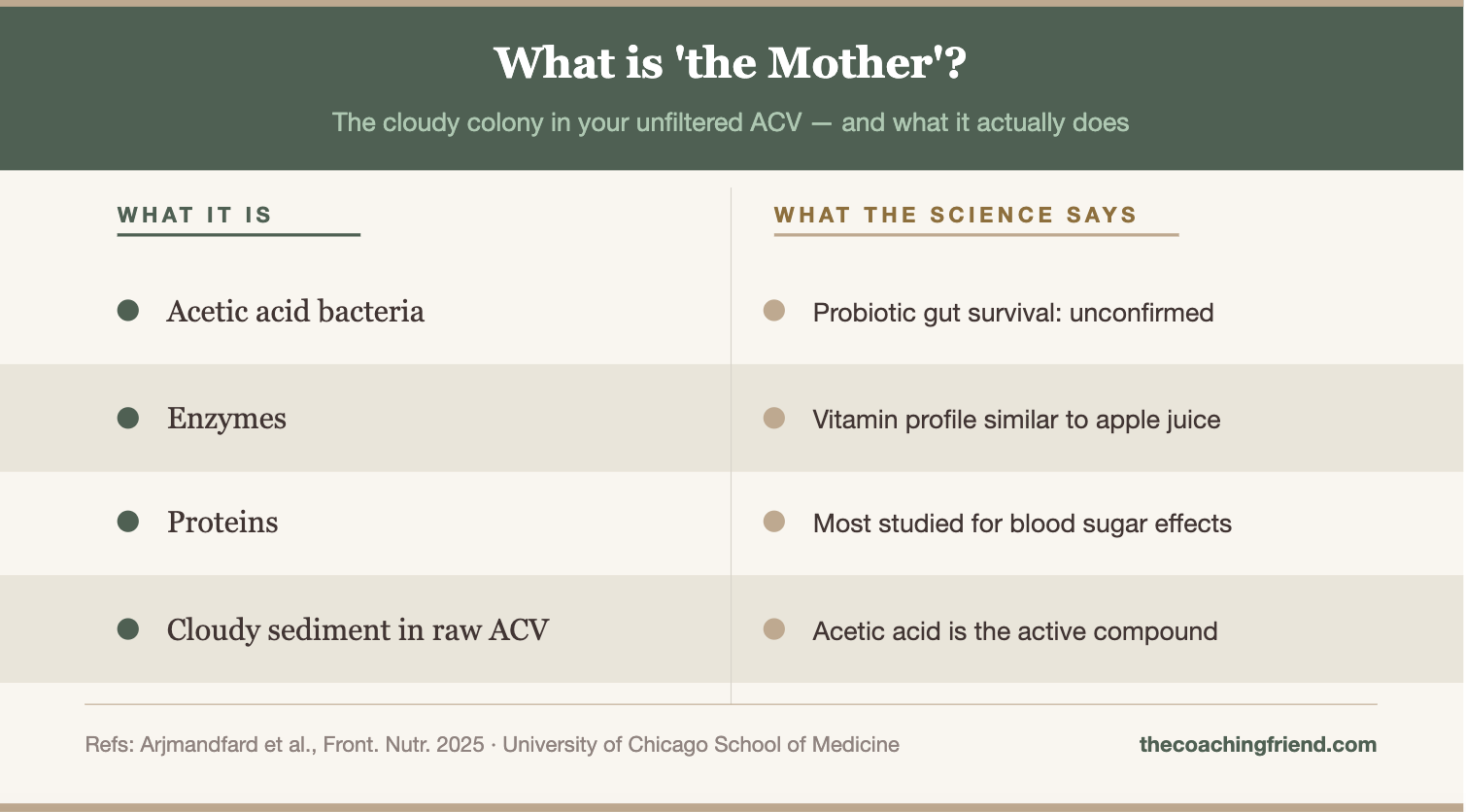
Infographic explaining what 'the Mother' in apple cider vinegar is and what the science says
The Claims vs. The Science
Here's where we separate the genuinely interesting from the outright fiction. And there is some genuinely interesting stuff — ACV is not total nonsense. But the gap between what the science shows and what the wellness world claims is significant.
One quick note that perfectly illustrates this gap: in 2024, a clinical trial claiming ACV caused overweight teenagers to lose an extraordinary amount of weight went viral worldwide, cited in hundreds of media articles. It was subsequently retracted by BMJ Group in September 2025 after independent experts found the data couldn't be replicated and the statistical values were implausible. Research integrity investigators noted the results would have made ACV roughly 50% more effective than GLP-1 medications. The study's widespread coverage and swift retraction is a near-perfect case study in why we wait for the science to settle before adding anything to the morning routine.
✅ Blood Sugar & Insulin Sensitivity — This One Actually Has Legs
This is ACV's strongest evidence base, and it's worth taking seriously. A 2025 systematic review and meta-analysis published in Frontiers in Nutrition — drawing on multiple randomised controlled trials and conducted by researchers at Shiraz University of Medical Sciences — found that daily ACV consumption significantly reduced fasting blood sugar and HbA1c levels in people with type 2 diabetes, particularly at doses of at least 10 ml per day [1]. A separate earlier meta-analysis confirmed that vinegar consumption attenuated postprandial glucose and insulin responses [2].
Why it might work: Acetic acid appears to slow gastric emptying — the rate at which your stomach passes food into the small intestine — which in turn slows glucose absorption into the bloodstream. Think of it as a natural speed bump for sugar.
The nuance: These effects are modest and most meaningful for people who already have insulin resistance or prediabetes. If your blood sugar is already well-regulated, the impact is likely minimal. ACV should never replace prescribed diabetes medication — it's a complement, not a substitute.
✅ Weight & Body Composition — A Supporting Player, Not the Star
A 2025 systematic review and meta-analysis published in Nutrients, screening over 2,900 reports and including 10 RCTs with 789 participants, found that daily ACV intake produced statistically significant reductions in body weight, BMI, and waist circumference in adults with obesity or type 2 diabetes. Higher doses (30 ml/day) produced greater reductions than lower doses [3].
We are talking modest but real effects, in addition to other dietary changes — not a standalone solution. It's a supporting actor, not the lead. If anyone is selling you ACV as a weight loss solution in its own right, back away slowly and with purpose.
⚠️ Cholesterol — Early Signals, Limited Evidence
Some studies point to reductions in LDL ("bad") cholesterol and modest increases in HDL ("good") cholesterol with regular ACV use. Findings are consistent enough to be interesting but the research base is small. File under: promising, not conclusive.
❌ Detox, Alkalising Your Body, Skin Cures, Cancer Prevention — A Hard No
Let's dispatch these efficiently.
Detox: Your liver and kidneys are detoxing your body continuously, around the clock, entirely for free, without requiring any vinegar. The concept of "detoxing" through a food or drink is not a medically recognised process. Your liver would like you to know it finds the implication slightly offensive.
Alkalising your blood: Your blood pH is maintained within an extremely narrow range by your kidneys and lungs, operating with extraordinary precision. Drinking something acidic does not alkalise your blood. If it did, that would be a medical emergency, not a wellness win.
Cancer prevention: No credible evidence. None.
Skin: Applying undiluted ACV to your skin can and does cause chemical burns. There are documented cases. Please don't.
If anyone is selling you a "detox ACV protocol," they are selling you vibes, a bottle of fermented apple juice, and a great deal of confidence.
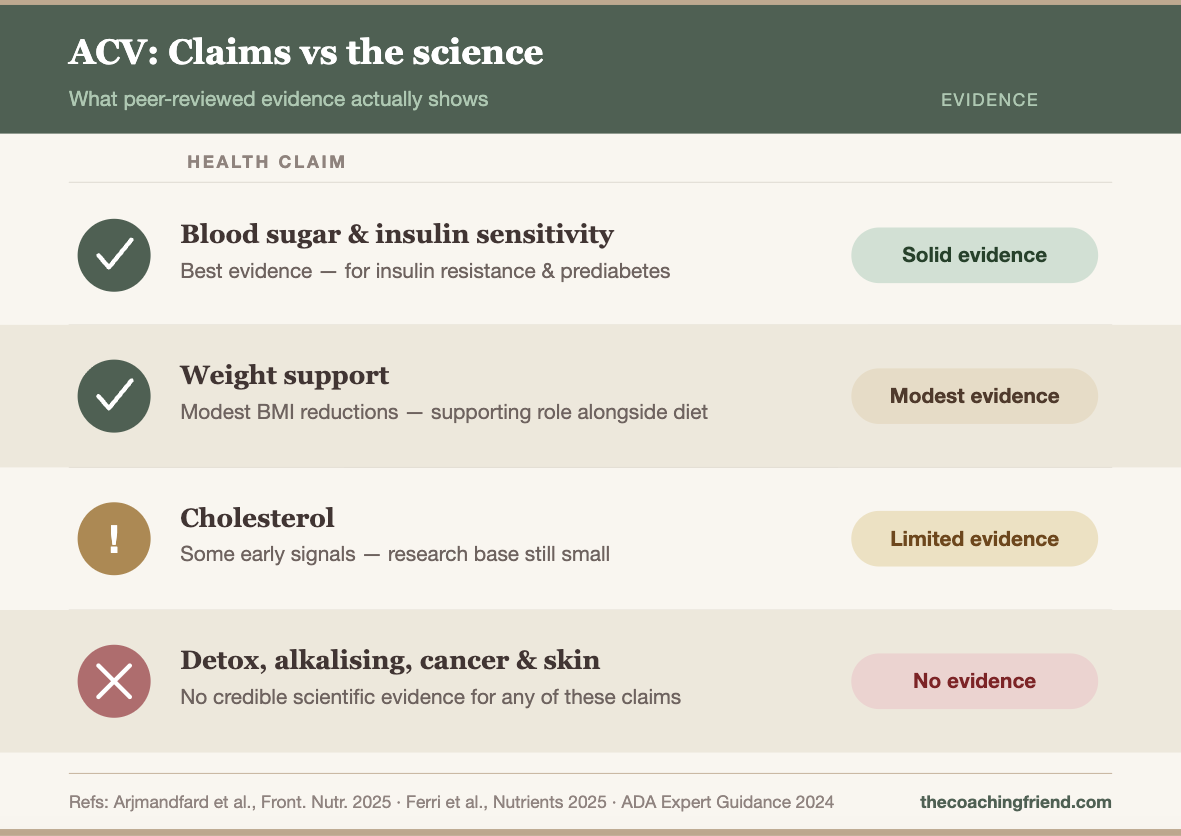
Apple cider vinegar health claims scorecard — what the science supports and what it doesn't
What the American Dental Association Would Like You to Know
ADA-affiliated dental experts have weighed in on ACV consumption, and the guidance is clear: the high acidity of apple cider vinegar can seriously damage tooth enamel if consumed undiluted or regularly without precautions [4]. The specific risks include enamel erosion leading to pain, increased cavities, and sensitivity. For those who choose to drink it: always dilute, use a straw, rinse your mouth with plain water immediately after, and wait at least 30–60 minutes before brushing.
That last point trips people up. Brushing immediately after an acid exposure scrubs away acid-softened enamel that saliva would otherwise help repair — it accelerates the damage rather than preventing it.
The tablet and gummy versions, often marketed as the convenient, teeth-friendly alternative, carry their own risks: some tablet formulations have been found to contain acid at concentrations significantly higher than liquid vinegar, and a tablet dissolving in a fixed location can cause concentrated acid irritation to the oesophagus [5]. The gummies are typically still acidic and sticky — your dentist will not be charmed.
So: liquid, properly diluted, through a straw, is the least bad option if you're going to do this.
If You've Read All of This and Still Want to Try It
Fair enough — here's how to do it sensibly.
Dose: 1–2 tablespoons (15–30 ml) per day, diluted in at least 8 oz / 240 ml of water. This is the range used in the studies showing benefit. More is not better — the risks scale up, the benefits don't.
Timing: For blood sugar support, drink it 10–20 minutes before a meal.
The non-negotiable rules:
- Always dilute. Always. Never take it as a shot. A pH of 3.1 hitting your bare oesophagus first thing in the morning is not a wellness ritual — it's a hazard.
- Use a straw to direct liquid past your teeth.
- Rinse your mouth with plain water immediately after drinking.
- Wait at least 30 minutes (ideally 60) before brushing — acid temporarily softens enamel and brushing on softened enamel accelerates the damage.
- Don't take it right before bed — lying down with residual acidity in your oesophagus is unpleasant at best and damaging at worst.
Unfiltered liquid with the Mother is what's been studied. Tablets and gummies are poorly regulated and carry higher risks. If you're going to do this, do the liquid version properly.
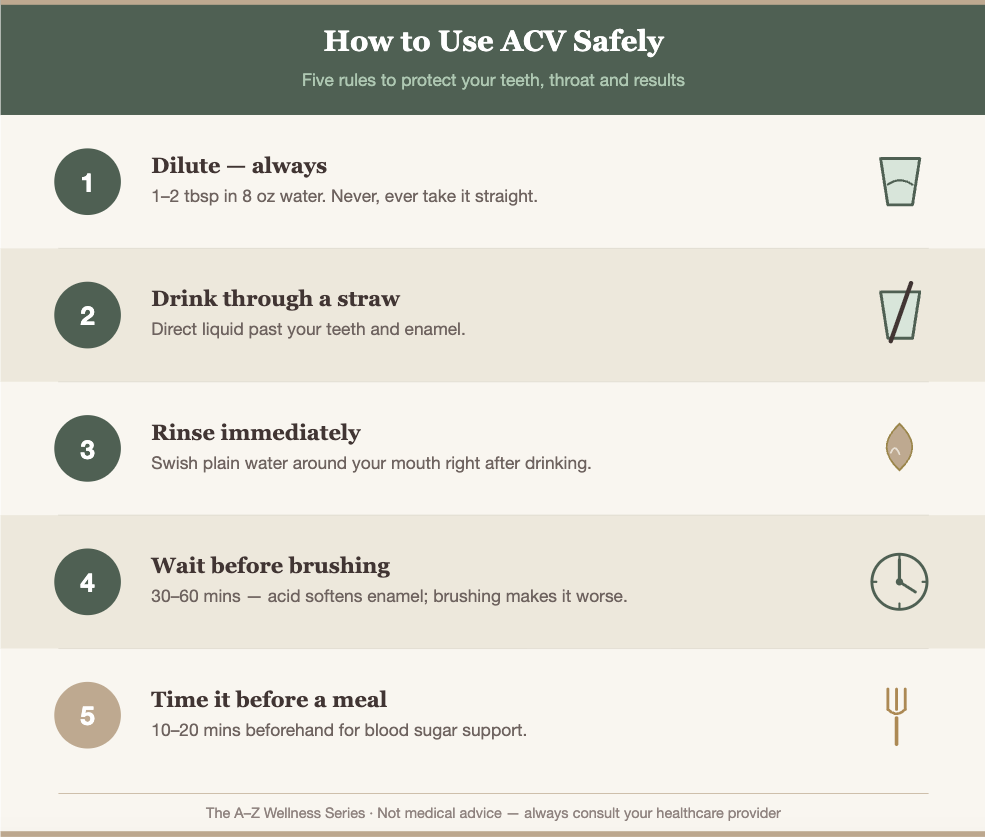
How to use apple cider vinegar safely — 5 rules to protect your teeth and oesophagus
Who Should Be Extra Cautious — or Skip It Entirely:
- Anyone on diabetes medication — ACV can amplify blood-sugar-lowering effects and create a compounding risk
- People with gastroparesis — your stomach is already emptying too slowly; slowing it further is the last thing you need
- Anyone with acid reflux or GERD — adding acidity to an already acidic situation is not the move
- People with low potassium — rare, but documented cases of hypokalaemia and bone density issues linked to excessive long-term use [5]
- Children — acetic acid is a documented cause of throat burns in children; keep out of reach [5]
- Pregnant or breastfeeding — supplemental use is best avoided; culinary use in food is generally considered fine
Age Considerations:
Teens & Young Adults: Tooth enamel is still developing through the mid-20s — the dental risk is particularly relevant here
Adults 30–60: The most-studied group; the blood sugar and modest weight support evidence applies most clearly
60+: Extra caution with blood pressure or diabetes medications; potassium-depletion risk more relevant when bone density is a concern
Pregnant / Breastfeeding: Avoid supplemental use
The Verdict
Apple cider vinegar is not a miracle. It's also not a complete scam. It's a modestly effective, inexpensive, low-risk tool — when used correctly — with genuine, if modest, evidence for blood sugar management and weight support, particularly for people with insulin resistance or obesity.
What it is not: a detox. A hormone reset. A cancer treatment. A skin cure. A hair growth solution. A meaningful probiotic. An alkalising agent. Or a reason to set your alarm 20 minutes early to do shots of fermented apple juice.
The honest summary of 7,000 years of ACV history is this: someone's wine went bad, ancient soldiers drank it because it was cheap, a health guru sold nine million books claiming it cured baldness, a viral weight-loss study turned out to be unreplicable and was retracted, Katy Perry is now a stakeholder, and the actual science says it's modestly useful for blood sugar — please use a straw, please don't shoot it, and honestly, just put it in a salad dressing.
Your oesophagus will thank you.
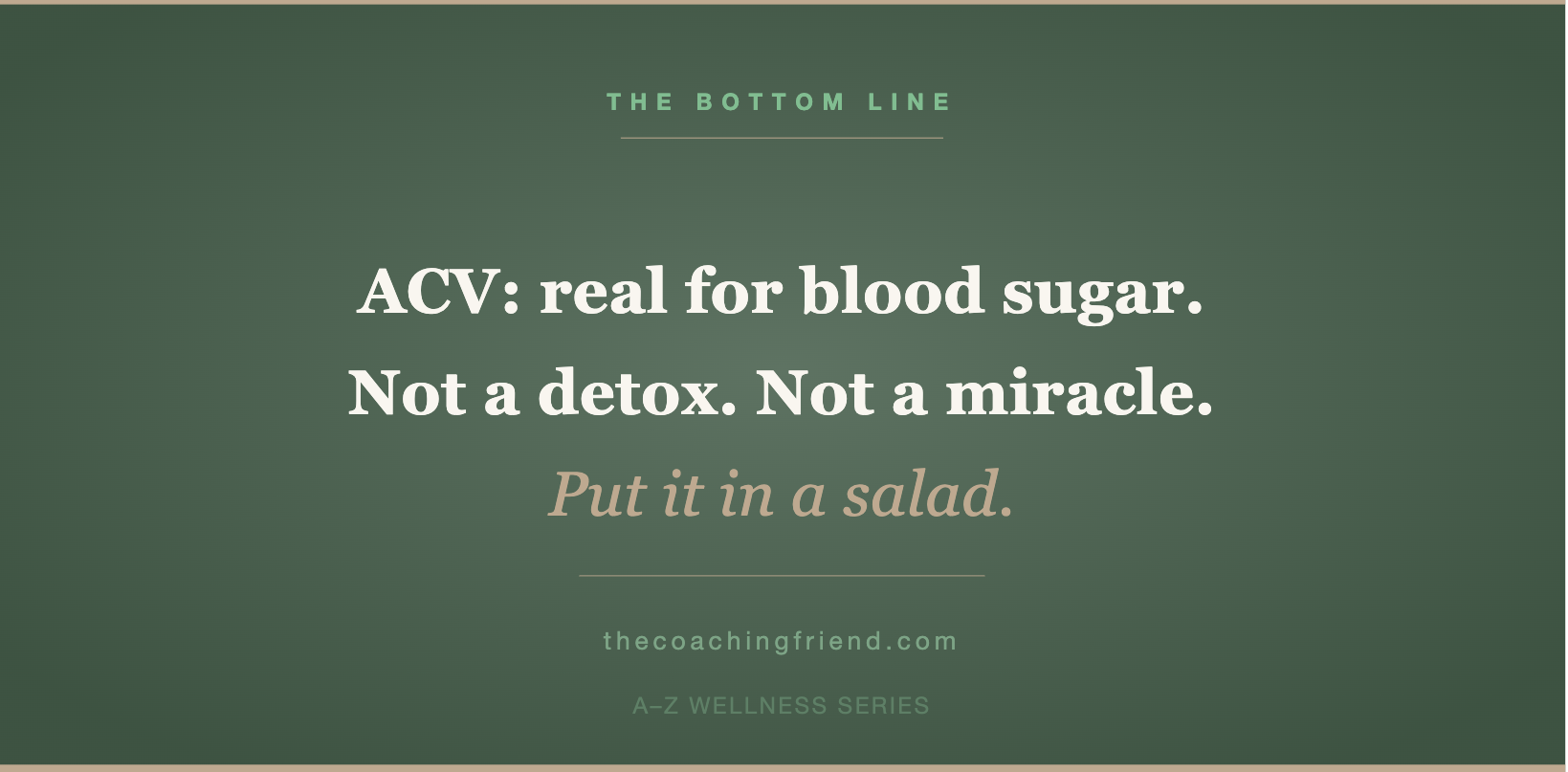
The Coaching Friend — apple cider vinegar: modest blood sugar benefits, not a miracle cure
Scientific References
1. Arjmandfard D, Behzadi M, Sohrabi Z, Mohammadi Sartang M. Effects of apple cider vinegar on glycemic control and insulin sensitivity in patients with type 2 diabetes: A GRADE-assessed systematic review and dose–response meta-analysis of controlled clinical trials. Frontiers in Nutrition. 2025;12:1528383. doi:10.3389/fnut.2025.1528383
2. Shishehbor F, Mansoori A, Shirani F. Vinegar consumption can attenuate postprandial glucose and insulin responses: a systematic review and meta-analysis of clinical trials. Diabetes Research and Clinical Practice. 2017;127:1–9. doi:10.1016/j.diabres.2017.01.021
3. Ferri FR, Battista RA, Giannini AA, et al. Effect of Apple Cider Vinegar Intake on Body Composition in Humans with Type 2 Diabetes and/or Overweight: A Systematic Review and Meta-Analysis of Randomized Controlled Trials. Nutrients. 2025. PMC12472926. doi:10.3390/nu17172984
4. Hewlett ER (UCLA School of Dentistry / ADA Consumer Advisor). Expert guidance on ACV and tooth enamel cited in: Helm J, Amidor T. Apple Cider Vinegar Benefits 2024. U.S. News & World Report. July 22, 2024. Referenced in ADA News: adanews.ada.org/huddles/experts-provide-latest-science-on-apple-cider-vinegar
5. National Institutes of Health — LiverTox / MedlinePlus. Apple Cider Vinegar: Side effects, safety, and drug interactions. Last updated 2024. Available at: medlineplus.gov & ncbi.nlm.nih.gov/books/NBK548536